
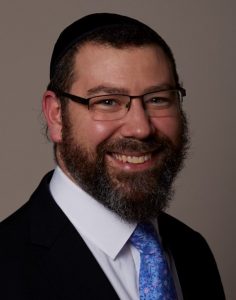
Rabbi Dr Moshe Freedman is an accomplished educator, academic, and researcher with a wide range of professional and voluntary multidisciplinary experience specialising in Jewish education, technical analysis, problem solving, and specialised consultancy. He has particular expertise in communicating complex and multifaceted concepts and viewpoints to diverse groups of people with different backgrounds.
Early Life and Education
Rabbi Freedman was born in Kingston-upon-Thames, Greater London and attended Tiffin School. Following his schooling he began his academic studies by studying Medical Electronics at the University of Liverpool before completing his Masters in Medical Physics at the University of Surrey in 2000. Following the completion of his MSc, Freedman began a PhD at the University of Surrey.
Academic Research
Freedman’s PhD[1] focussed on applying complex signal processing techniques to a novel device using Electrical Impedance Epigastrography (EIE) which passed small electric currents through left epigastric region (the upper part of your abdomen situated just below your rib cage) which covers the body and pyloric regions of the stomach, to measure changes in impedance. These changes in impedance correlate with gastric motility and contractility allowing for a non-invasive method of measuring gastric activity. Freedman used statistical analysis and data processing to extract physiologically significant measures from the data collected and published a number of academic papers.[2][3][4]
Jewish Education
During his time at university, Freedman became involved in informal Jewish education through the Union of Jewish Students (UJS). On completion of his PhD in 2004 he joined David Shapell College of Jewish Studies / Yeshiva Darché Noam in Jerusalem completing his semicha in 2008. During that time, Freedman became fascinated in the intersections between science and religion.
Rabbinic Career
Rabbi Freedman returned to the United Kingdom and was appointed the community rabbi at Northwood United Synagogue in 2009. In 2012 he also joined the Canary Wharf Multifaith Chaplaincy which serves the professionals who work on the Canary Wharf business district. In 2015 he joined the New West End Synagogue in central London. As well as his communal duties, Rabbi Freedman served on the Rabbinical Council of the United Synagogue between 2014 and 2023.
Rabbi Freedman left the rabbinate in 2023 to focus on Jewish education and now heads Mah Shetashiv which is an online hub of Jewish educational resources and inspirational material.[5]
Advisory Roles
Rabbi Freedman was a faith advisor to the e Royal College of Pathologists and in October 2019 he was appointed co-vice-chair to the Moral and Ethical Advisory Group (MEAG) which advised the Department of Health and Social Care on moral and ethical issues during the Covid-19 pandemic as well as other matters related to public health in the United Kingdom. He also served on an expert panel advising the government on banning the practice of hymenoplasty alongside other procedures which specifically harm women, such as female genital mutilation. This ban came into force and was widely reported in the national press in 2022.
Writing and Lecturing
Rabbi Freedman has lectured, written, and published hundreds of articles on a variety of subjects, specialising in science and Torah, as well as contemporary ethics and religious law. Many of his articles can now be found on the Mah Shetashiv website. During the Covid-19 pandemic he encouraged members of the Jewish community to get vaccinated and gave talks about vaccination in Jewish law.[6]
Opinions and Controversies
Progressive Judaism
In July 2017 Rabbi Freedman was invited to speak about a new study by the Institute for Jewish Policy Research which indicated that membership of central orthodox synagogues was falling while in progressive communities it was on the rise. Freedman courted controversy while being interviewed for a BBC Sunday programme on Radio 4 when he suggested that the study was unscientific given that it made a direct comparison between two communities who have radically different perspectives on Jewish identity. Freedman’s comments sparked some backlash in the Jewish media[7] although some were sympathetic to his strident position.[8]
Assisted dying
Freedman has spoken out against assisted dying. In 2021 together with Dr Aryeh Greenberg, a specialist registrar in clinical oncology, Freedman responded to a letter in the British Medical Journal (BMJ) by Rabbi Dr Jonathan Romain and the former Archbishop of Canterbury, George Carey who had claimed that religious leaders supported assisted dying.[9] Freedman and Greenberg wrote a response which garnered much attention.[10]
In it they wrote that:
“The Torah (e.g., Exodus 21:19) obligates us to care for those who are unwell, and the Talmud famously equates the saving of life with the saving of an entire world (Sanhedrin 37a). When faced with such tragic circumstances, Jewish law permits us to pray for a terminally ill patient to die in order to relieve their suffering, for while this expresses a compassionate human response towards others, the responsibility of deciding the moment of death firmly remains a Divine prerogative. God mandates that humans intervene to heal but clearly forbids taking a life (Genesis 9:6, Exodus 20:13 and Deuteronomy 5:17).“
They further asserted that:
“The authors state that the “God barrier has long been pushed aside both at the beginning and end of life, with humans acting in lieu of God.” There is no theological comparison between the creation of new life through fertility treatments, the saving and prolonging of life through medical intervention versus the premature active ending of life through doctor-assisted dying, irrespective of the actor’s good intentions. … attempting to rationalise doctor-assisted dying in theological terms even to relieve suffering, the authors have rooted their own moral anchors outside their faith traditions.“
Covid-19 pandemic
During the beginning of the Covid-19 pandemic, Freedman became aware that some members of the wider Jewish community had started to arrange unlawful gatherings for prayers. On social media, Freedman likened this to idol worship given that while it was certainly preferable to pray with a minyan (a gathering of ten Jewish males over the age of bar mitzvah) the preservation of life was a much greater imperative.[11]
Current Profession
In September 2023, following fourteen years as a community rabbi, Rabbi Freedman returned to his academic roots in medical research as a Business Analyst and Process Improvement Specialist for a Clinical Research Organisation specialising in Pharmacovigilance, working on exciting projects using Artificial Intelligence, Machine Learning, and Large Language Models.[12]
Contact
To contact Rabbi Freedman please email office@mahshetashiv.com.
References
- Processing and analysis of Electrical Impedance Epigastrography signals for investigation and modelling of gastric motility in humans
- Physiological interpretation of electrical impedance epigastrography measurements
- Modelling of electrical impedance epigastrography signals to investigate the efficacy of a motion artifact rejection algorithm
- Verification of a simple technique for the removal of motion artefacts in electrical impedance epigastrography signals
- Mah Shetashiv
- Vaccination in Jewish Law and Thought
- Concern over US rabbi’s Reform slur
- US Rabbi displays courage and conviction
- There is nothing holy about agony: religious people and leaders support assisted dying too
- Religious support for assisted dying: moral anchors are rooted outside faith traditions
- Moshe Freedman on LinkedIn